




I have been thinking about my late father a lot recently as we approach nine years since he passed away. As anyone who has read my book will know, my personal story is a very unique one, but while reflecting, my thoughts drifted onto blood types as it often does. I did a home blood test on him before he died at age 93, and he was a Blood Type A. Why did I test him? I wanted to see if his characteristics and lifestyle habits reflected his longevity, but that is a story for another day.
What is important to note is that we all inherit unique characteristics from our parents. We often hear the phrase “Doesn’t he look like his dad” from friends and relatives, and many of us can recognise a trait or two that has been passed down from their father. However, did you know that your blood type is one of those inherited gifts too?
Long before you were born, both your mother and your father contributed equally to your genetic blueprint (DNA). At the moment of conception, you inherited genes from each parent that determine many of your natural characteristics, including, but not limited to your eye colour, hair colour, left handed or right-handedness, and importantly your blood type.
Each parent carries two blood type genes (called alleles) but passes only one of them to their child. The combination of the gene inherited from your mother and the one inherited from your father determines your blood type.
For example:
- If both parents pass on a Blood Type A gene, you will have Blood Type A.
- If both pass on a Blood Type B gene, you will have Blood Type B.
- If both pass on a Blood Type O gene, you will have Blood Type O.
- If one parent passes on a Blood Type A gene and the other passes on a Blood Type B gene, you will have Blood Type AB.
Although your blood type is determined by both of your parents, understanding your father's contribution is an important part of discovering your own unique genetic story.
Understanding Dominant and Recessive Blood Type Genes
This is where things become a little more interesting. Not all blood type genes have the same influence. Blood Type A and Blood Type B genes are dominant, while the Blood Type O gene is recessive.
What does this mean?
If you inherit a Blood Type O gene together with either a Blood Type A or Blood Type B gene, the dominant A or B gene determines your blood type. The recessive Type O gene is still present, but it is not expressed.
For example, if your mother has Blood Type O and your father has Blood Type B, and you inherit the O gene from your mother and the B gene from your father, your blood type will be Blood Type B because the father's B gene is dominant over the O gene.
In simple terms:
- A + O = Blood Type A
- B + O = Blood Type B
- O + O = Blood Type O
- A + B = Blood Type AB (both A and B are dominant and are expressed together)
Understanding how dominant and recessive genes work helps explain why children can sometimes have a different blood type from one or even both of their parents, while still inheriting genes from each of them.
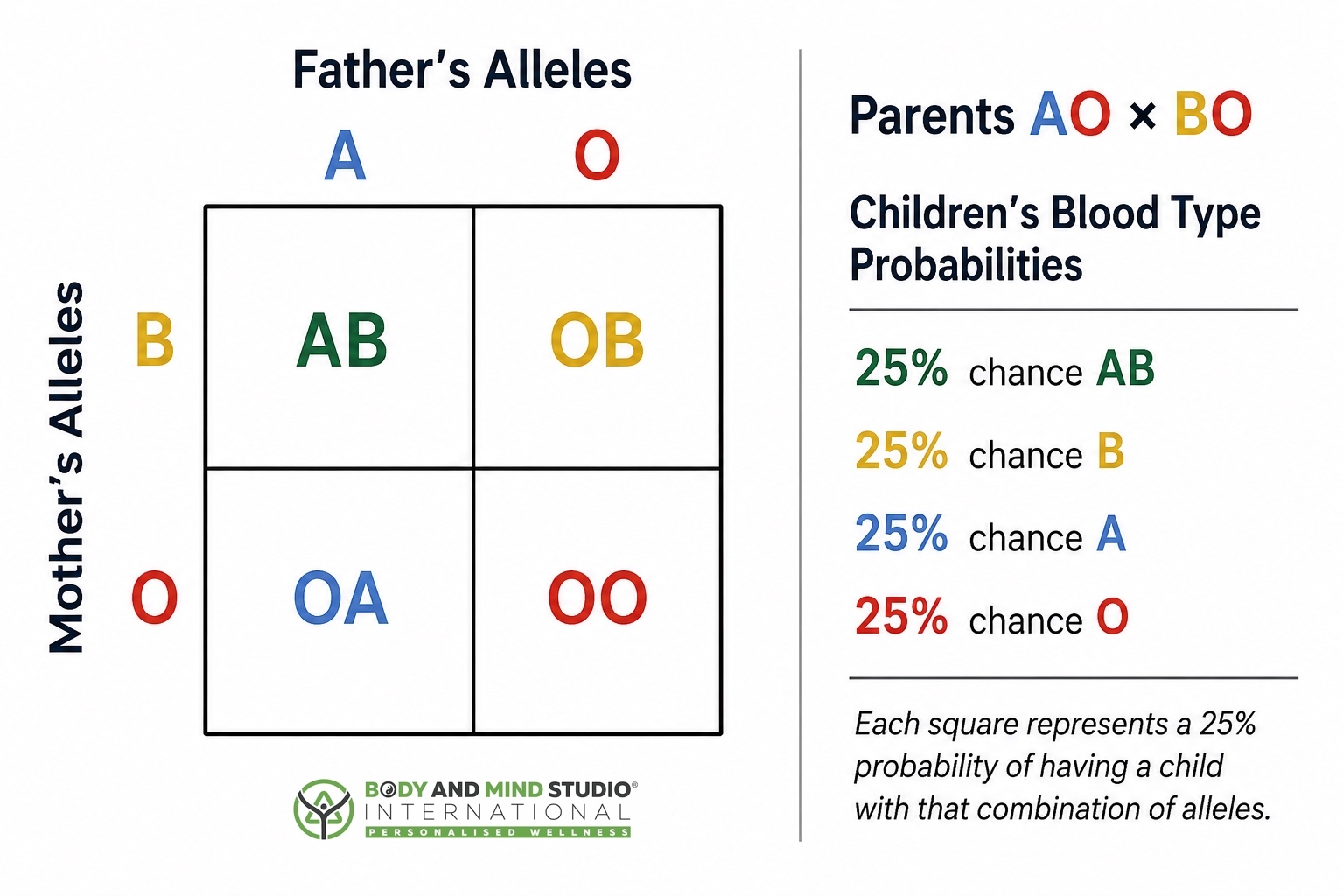
The chart illustrates a parent with Blood Type A who carries a recessive Type O allele (top of the chart) and a parent with Blood Type B who also carries a recessive Type O allele (left side of the chart). Because each parent can pass on either of their two alleles, every pregnancy has four equally likely outcomes. This means there is a:
- 25% chance that their child will have Blood Type A
- 25% chance of Blood Type B
- 25% chance of Blood Type AB
- 25% chance of Blood Type O
Returning to You and Your Dad...
Because of the many possible combinations of dominant and recessive alleles, discovering the exact genotype your parents carry often requires looking back through several generations of your family tree. If genetics fascinates you, it's a rewarding subject to explore.
Otherwise, simply be thankful for the many characteristics you've inherited from your dad, from the obvious family resemblance to the genetic contribution that helped determine your unique blood type.
If you don't know your blood type and why it is an important factor to consider as part of your health and wellbeing routine, click here to find out more about blood types and personalised nutrition.
About the Author - Paul Hopfensperger MIfHI
Paul Hopfensperger is a Naturopathic Health Coach at Body and Mind Studio International® and is a United Kingdom based Fellow cum laude and Master Instructor for Dr. Peter J D'Adamo's Institute for Human Individuality. He specialises in Blood Type Nutrition™ consultancy and services. He was the first and only person from the UK to attend the inaugural OPUS23 Genomic Bioinformatics training seminar conducted by Dr D'Adamo at the Center of Excellence in Generative Medicine, University of Bridgeport College of Naturopathic Medicine, USA in April 2016. Paul also holds a CIBTAC diploma in Diet and Nutrition, and a post graduate diploma in Chinese Nutritional Therapy from The College of Naturopathic Medicine in London. Paul is also a Maxwell Leadership Certified Team Member and International #1 Best-selling Author.
Disclaimer:
Information and other content provided in Body and Mind Studio International® blogs should not be construed as medical advice and should not be considered a substitute for professional medical expertise. If you have any medical concerns, you should consult with your health care provider.
